On a recent Uber ride, I found myself in a familiar situation. The suggested route felt suboptimal. I knew a better one, not faster in kilometres, but more comfortable and less congested at that hour. I asked the driver to take an alternative.
What I realised in that moment was that the app had no mechanism for either of us to confirm what had just been agreed. The deviation from the suggested route would simply appear in the data, with no record of why it happened. For the driver, any suspicion of fare manipulation. For me, no guarantee the agreement would be honoured.
This is a trust gap that a single feature could close.
The Proposal: Route Preference Confirmation
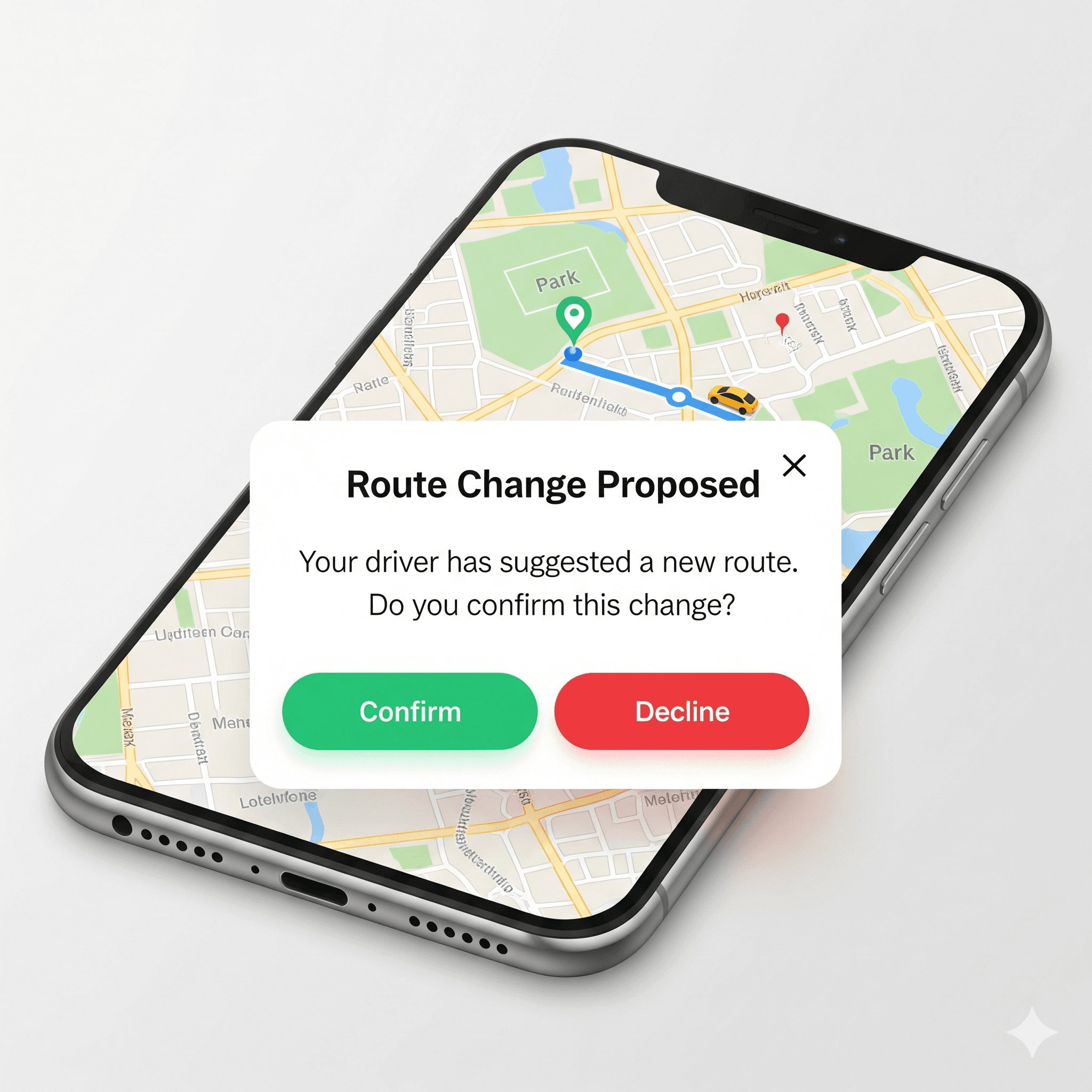
When either a driver or passenger initiates a deviation from the app's suggested route, the other party receives a confirmation prompt before the change takes effect.
Driver-initiated deviation: If a driver adjusts the route during a trip, the passenger receives a notification: "Your driver has suggested a route change. Accept / Decline / Chat with driver."
Passenger-initiated change: If a passenger requests an alternative route, the driver receives the same prompt, confirming that the change was a passenger preference, not a driver decision.
All confirmations are logged. The audit trail is complete.
Why This Matters
The core problem is asymmetric information. When a route deviation happens, neither party has a verified record of why. The result is suspicion, of the driver inflating the fare, of the passenger exploiting the driver's local knowledge, of the app failing to capture what actually happened.
The confirmation prompt eliminates this ambiguity. It does not add friction to trips where the route stays as suggested, the vast majority of rides. It adds one step to the small minority of trips where a deviation happens, and it makes that step meaningful.
Enhanced transparency: The reason for every route deviation is documented and accessible to both parties. Disputes become resolvable with data rather than competing accounts.
Reduced suspicion: Drivers are protected from accusations of intentional detours. Passengers are protected from unexplained fare increases. The app becomes the trusted third party it should already be.
Better communication: The feature creates a structured moment for driver and passenger to align, reducing the awkwardness of mid-trip negotiation conducted through a rear-view mirror.
Passenger control: Users who have a preferred route for legitimate reasons, comfort, local knowledge, privacy, can assert that preference within the app rather than relying on a verbal agreement that leaves no record.
The Broader Principle
Trust in platform-mediated services erodes when users feel the platform is indifferent to disputes between its parties. Uber's convenience advantage is significant, but it is not unconditional. Every unresolved suspicion about a route or a fare is a small withdrawal from the trust account.
A Route Preference Confirmation feature is not primarily a fraud prevention tool. It is a statement about which side Uber takes when something goes wrong, and the answer should be: it takes the side of clarity.
Great product design anticipates the moments where trust is at risk and removes the ambiguity before the dispute starts.