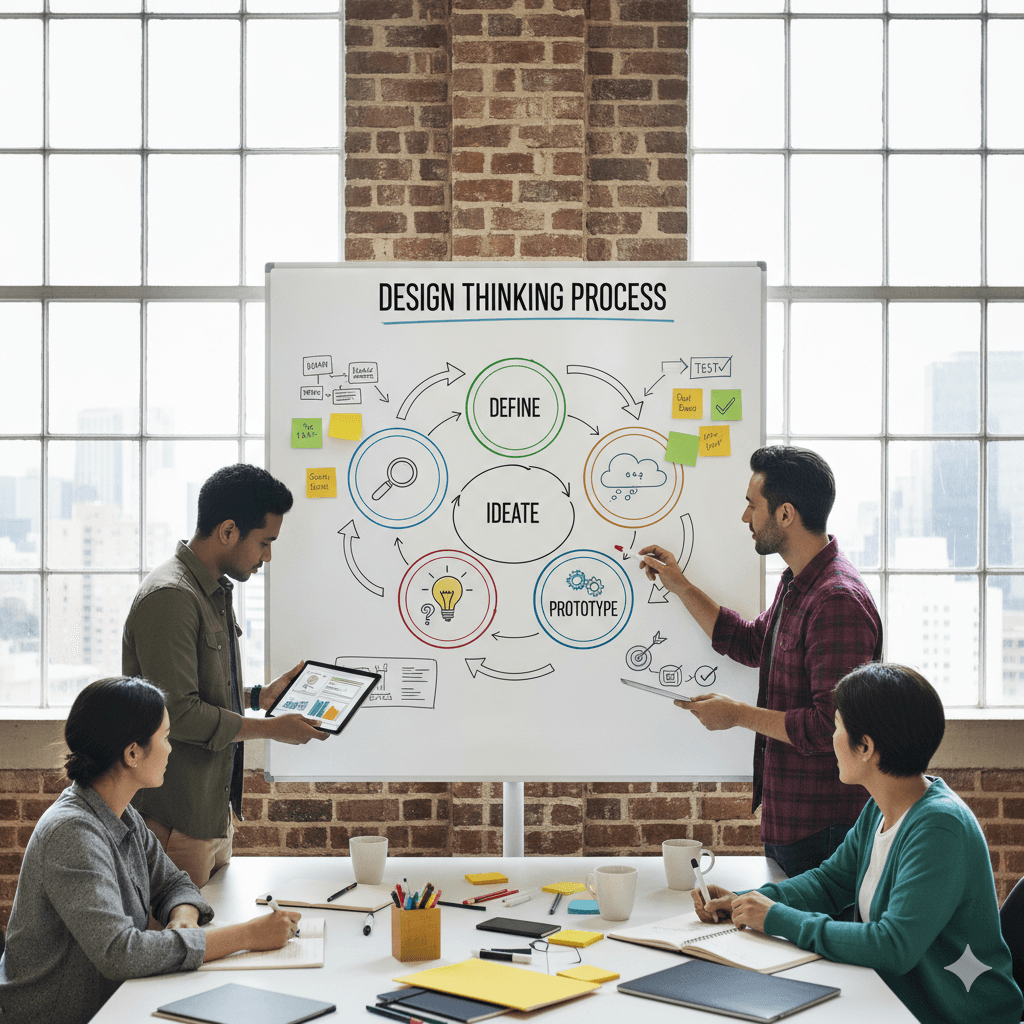
Design thinking is a human-centered approach to problem-solving. It is not a discipline reserved for designers. Engineers, educators, entrepreneurs, and product managers use it to solve complex problems by starting with a deep understanding of the people they are designing for.
The approach is powerful because it challenges the assumption that we already know what users need. Most failed products were built on confident assumptions about user behaviour that turned out to be wrong. Design thinking replaces assumption with observation, and opinion with empathy.
The Five Stages
1. Empathize
Before defining any problem, you must understand the people experiencing it. This means observing users in their natural context, asking open-ended questions, and setting aside your own biases and preconceptions.
The goal is not to gather data points but to develop genuine insight into people's motivations, frustrations, and behaviours. What workarounds have they built? What do they complain about? What do they silently tolerate?
2. Define
Once you have gathered enough observations, you synthesize what you have learned into a clear problem statement. The best problem statements are human-centered and written from the user's perspective.
A useful format is the "How might we...?" question. Instead of "We need to improve our onboarding flow," you write "How might we help a first-time user feel confident within their first five minutes?" The framing shifts the focus from your solution to their experience.
3. Ideate
With a clear problem statement, you generate as many possible solutions as you can, without judging any of them. Quantity before quality. Wild ideas are welcome because they often contain the seed of a practical solution.
The best ideation sessions are time-boxed, structured, and collaborative. Diverse perspectives produce better ideas than a single expert working alone.
4. Prototype
You cannot learn from an idea on a whiteboard. Prototyping means creating a tangible, low-fidelity version of your solution quickly and cheaply, for the sole purpose of learning.
A prototype is not a finished product. It is a question made physical. The question is: "Does this idea actually work for the people we are designing for?"
5. Test
You put the prototype in front of real users and observe. You are not looking for compliments. You are looking for confusion, hesitation, and failure. Every observation tells you something that improves the next iteration.
Testing is not the end of the process. It feeds back into Empathize and Define, creating a continuous loop.
Why It Works
Design thinking works because it starts with people, not products. Real-world examples span decades: the intuitive interface of the original iPhone, the trust-building redesign of Airbnb's booking experience, and the classroom layouts that improved student engagement in schools.
The mindset it requires, curiosity, deep listening, and a willingness to be wrong early, is accessible to anyone willing to practice it. It is not a talent. It is a discipline.