The Nigerian payment sector is undergoing a significant transformation. At its centre is the migration to ISO 20022, a global standard for financial messaging that represents a fundamental shift in how payments and financial information are exchanged, not a routine software upgrade.
For project managers embedded in this work, the migration presents challenges that are simultaneously technical, regulatory, and human. This is a perspective on how to navigate them.
What ISO 20022 Actually Changes
Previous messaging standards were built for simple, structured transactions. ISO 20022 enables richer, more structured data to travel alongside payments, enabling better fraud detection, improved compliance reporting, and more transparent cross-border transactions.
For financial institutions, this is not a configuration change. It requires rethinking data models, updating integration points across multiple systems, retraining operations teams, and coordinating with counterparties who are migrating on their own timelines.
The Case for Agile Methodology
The complexity and regulatory nature of this work makes waterfall planning inadequate. Requirements evolve as regulators issue updated guidance. Technical discoveries during integration surface new constraints. Counterparty readiness shifts.
An agile approach breaks the migration into manageable sprints with continuous feedback and adjustment built in. Each sprint has a clear goal, a review point, and an explicit mechanism for incorporating new information without derailing the whole programme.
This is not agile as a philosophy. It is agile as a practical response to working on a moving target with significant downstream impact.
Handling Mid-Course Requirement Changes
Requirement changes mid-migration are not an edge case, they are expected. Regulatory bodies refine their guidance. Technical constraints emerge only after integration work begins. Counterparties change their timelines.
When requirements change, the response must be systematic: reassess the timeline, re-evaluate the budget, identify what completed work needs to be revisited for compatibility. None of this is pleasant. All of it is necessary.
The discipline that makes this manageable is documentation. Every requirement change must be formally recorded, with its rationale, its impact assessment, and the stakeholder sign-off that authorised the adjustment. Without this, the team loses its audit trail and its ability to explain deviations to regulators.
"The greatest danger in times of turbulence is not the turbulence; it is to act with yesterday's logic."
Managing User Experience Through the Transition
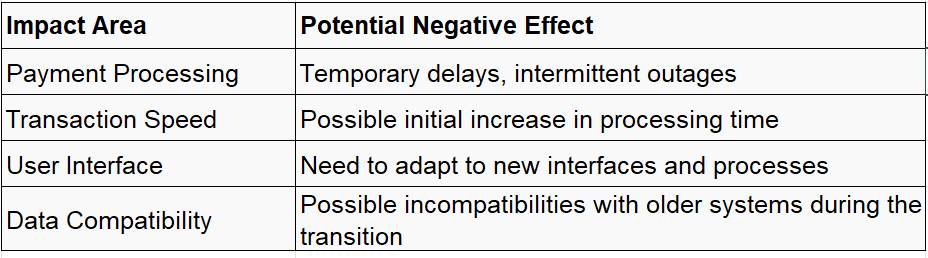
Migrations of this scale inevitably create friction for end users: temporary service disruptions, increased transaction processing times, and new interfaces or workflows to learn.
The mitigation strategy has three components. First, communicate proactively and clearly, users who understand why a change is happening and what to expect are significantly more tolerant than users who encounter unexplained disruption. Second, invest in comprehensive user training before go-live, not after problems emerge. Third, test rigorously and in stages, never migrate a high-stakes system in a single cutover without having validated the new environment under realistic conditions.
What This Migration Reveals
The ISO 20022 migration is a microcosm of every large-scale infrastructure change in regulated industries. The technical work is real but not the hardest part. The hardest parts are alignment, across teams, across institutions, across regulators, and communication, clear, consistent, and proactive at every level.
Project managers who navigate this well are not the ones who built the best Gantt chart. They are the ones who understood that their primary job was managing uncertainty and maintaining trust.